

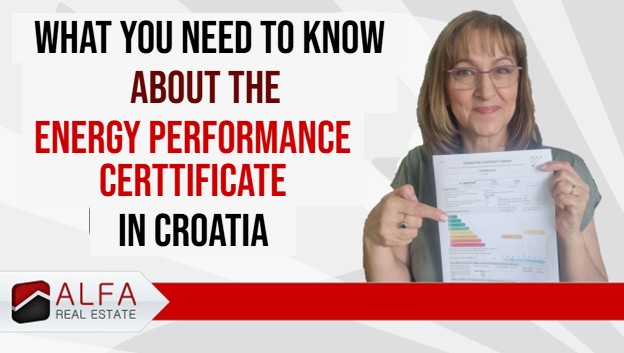
When we in Croatia mention to real estate sellers that, in addition to all other documents, they also need to obtain an energy certificate, you can’t imagine how many additional questions we get: What is it? Who does it? Why does it have to be obtained? Where can it be obtained? How quickly can it be done? How much does it cost? Can only an apartment have one or does the entire building need one? Do I have to have the original or can a copy be obtained? You will find answers to all these and other similar questions in this article.
I recently had an interesting situation with a client who asked me if he could go to “HEP Elektra” to issue him an energy certificate. I found it really cute because somehow people associate this certificate with electricity consumption. However, an energy certificate doesn’t actually tell you how much electricity you use, but rather shows you how energy efficient your property is, or how much it saves energy. It is mandatory when selling real estate and must be issued by someone with the appropriate qualifications and authorization, which are energy certifiers.
Below you will find answers to many interesting questions related to the certificate, where you can rarely find in one place and which I share with you here from the perspective and experience of a real estate agent.
1. How is the energy class determined in an energy certificate?
An energy certificate actually presents the energy properties of a building and gives the buyer an insight into what the heating and cooling costs will be, and it is prepared by energy certifiers who are the only ones authorized to conduct a detailed inspection and issue a valid document. The certifier should come to your property, take pictures of everything that is important to him, do a detailed analysis, and after a certain study, the energy class is calculated and you are issued a certificate.
The energy class rating system is based on letters that go from A+ to G.
• A+ indicates the best energy efficiency, which means that the building is very energy-efficient and the heating and cooling costs are extremely low.
• G indicates the worst energy efficiency, which means that the building consumes a lot of energy and the heating and cooling costs are extremely high.

2. What does an energy certificate look like?
The first, most important page of each certificate contains the most important information, such as: whether it was issued for an apartment or for the entire building, for which cadastral plot it was issued, at what address, who is the owner, what is the square footage, which letter or class was assigned, who made it, and how long it is valid. The first page must include the name and surname of the energy certifier, as well as his signature and seal.
3. Do I need to have the entire certificate or is only the first page sufficient?
Although only the first page is often used as proof that the certificate exists and that it shows key information, when selling, it is good to have the entire certificate, which includes the report on the inspection carried out. The complete certificate contains about 30 pages. Buyers may want to see more details about the energy status of the property they are buying, so it is good to be prepared and have it available.
4. Do I need to have the original document of the entire certificate?
It is not necessary to enclose the original of the energy certificate when selling a property, a copy is sufficient. However, if you have the original, it is certainly an additional advantage.
5. If the entire building does not have an energy certificate, can I request that a certificate be made only for my apartment located in that building?
Sometimes the entire building on a certain plot has an energy certificate, and if you have an apartment in that building, on the same cadastral plot, then you do not need to have it made, because the entire building has one. And of course you must have at least the first page that proves it.
But if you are selling an apartment in a building, and a certificate has never been issued for that entire building, then you need to have a certificate made only for that apartment of yours. In that case, the entire building does not need a certificate, but only the apartment of yours that you are selling.

6. How long is an energy certificate valid?
Energy certificates have an expiration date. Each certificate is valid for 10 years from the date of issue. If you already have a valid certificate and plan to sell within that period, there is no need to make a new one for the same property. When selling a property, be sure to check the expiration date.
7. What if I have a certificate, but it has recently expired?
If you are selling a property and your certificate has expired, you will need to get a new one. The energy certificate must be valid at the time of sale.
8. Do I need a certificate if I am not selling the property?
If you are not selling the property, you do not need a certificate until you decide to put it on the market.
9. How long does it take to produce a certificate?
The time it takes to produce an energy certificate depends on the complexity of the building, the availability of the certifier and how urgent it is, but on average the making process takes from a few days to a few weeks. That is why it is important to start this procedure on time, so that you have it before the sale and so that it is mentioned in the purchase agreement.
10. Do only new buildings need an energy certificate or do old buildings also have to have one?
An energy certificate is mandatory for all buildings, both new and old, regardless of the year of construction. Certification is legally required at the time of sale.

11. Which properties must have an energy certificate?
Since 2013, every property sold in Croatia must have an energy certificate. Every flat/apartment that is sold, house, commercial premises or building, must have a valid certificate before sale.
12. Where and how can I find an authorized certifier?
The good news is that they are easy to find with a little internet search. It is best to find a certifier who is located near the property you want to certify, as this can speed up the entire process. Don’t forget to ask about the certifier’s availability and timeframes, because if you need the certificate in a short time, the price will probably depend on this. Short but detailed communication will ensure that the entire process goes smoothly and without stress.
13. What information does the certifier need to create a certificate?
In order for the certifier to start the certification process, he will ask you for information such as: title deed (ZK extract), year of construction, address, floor plan, etc. If you do not have any of the above, the certifier will work with what they have or will help you get as much information as they need.
14. How much does it cost to create an energy certificate?
When it comes to the cost of certification, I can say from my experience that prices vary because there are several factors that determine them. Each certifier has its own price, so it is always important to tell what kind of property it is, where the property is and how urgent it is, so that he can form a price for you.
Just for example, in October 2024, one of our clients was issued a certificate for 120 euros, for a 50 m² apartment and it was issued in a week.
For some, urgency is important when creating a certificate, and for others, price is important, so it is best to consult several certifiers and choose the one that suits you best.
15. Do I as the owner have to have a certificate drawn up for my property or can someone else request it for me?
The certifier is concerned about who pays for the certificate. This means that someone else can order it for you, but you or that person must arrange the inspection of the property and ultimately pay. It is important to make precise arrangements with the person who arranges it for you, in order to avoid misunderstandings and ensure that the certifier is paid on time.

16. How can an energy certificate affect sales?
Yes, it may seem like a formality to you, but buyers really appreciate properties that will reduce their costs in the long run. Let’s say you have two similar properties – one with an A certificate and the other with a D certificate. Which property would you choose? It is quite clear that you will opt for the one that will save you more energy and where you will ultimately pay lower bills. This information from the certificate may not be the most important in the process of buying a property, but it is certainly becoming increasingly important.
Conclusion:
An energy certificate is by no means just a formality, but a legal obligation and also a necessary document that can facilitate the sale of your property. If you do not have one yet and are thinking about selling it, I advise you to consult with an authorized certifier in a timely manner and ensure that you have everything you need in a timely manner.
For all specific questions about prices and certification, it is best to contact one of the authorized certifiers.
If you have read this text to the end, I hope it was useful to you and that you found answers to your questions.
And finally, I would like to greet Ms. Dagmar, who gave me the inspiration for this text. Thank you for the motivation 🙂
If you also have a question or topic that you would like to discuss, feel free to write to me at: alfadizajn5@gmail.com. Your ideas are always welcome!
If you are the owner of a property in Vodice and want to sell it through our agency, but do not have an energy certificate, be sure to contact us because our team will help you both with the sale and in organizing the certificate to be made for you in time before the sale.
All properties in our offer already have a valid energy certificate, so they are ready to sell and buy without any additional worries. If you are interested in any of the properties, please contact us for more information!
A video was also recorded on this same topic, which you can watch here. It is recorded in Croatian, but you have subtitles in English.
__________________________________________________________
Author : Jasminka Fišer Gavranović – Owner of Alfa nekretnine real estate agency in Vodice, licensed real estate agent and home staging expert
📍 Alfa nekretnine, Obala Juričev Ive Cote 27, Vodice
📞 Tel.: 022 441 292 | Mob.: 091 525 3260
✉️ Email: info@alfanekretnine.hr
Follow us:
🌐 YouTube | Facebook | LinkedIn | Instagram | TikTok
_____________________________________________________________________________________
About the Author

Jasminka Fišer Gavranović is a long-standing licensed Croatian real estate agent with many years of professional experience. Born in Slavonia and raised in Zagreb, she spent a short period living in London before eventually settling with her family in Dalmatia, in the beautiful Croatian coastal town of Vodice.
After working in a variety of professions in Zagreb, she found her true calling in the real estate sector in Vodice — a field she genuinely enjoys and now runs together with her husband, Frano.
Since 2005, she has been actively involved in real estate brokerage, specializing in property sales and purchases in Vodice area. Together with her team at Alfa Nekretnine, she has initiated and managed a number of distinctive projects that have set the agency apart on the local market. One of her achievements was participating, in 2011, as one of the few real estate professionals in Croatia, in the popular American half-hour TV show “House Hunters International.” In the episode, she hosted her Australian client and guided them through the property-buying process in Vodice, showcasing the town to viewers around the world. This proved to be excellent promotion not only for her agency, but also for the destination of Vodice itself.
Through many years of hands-on work in real estate, she has seen every kind of apartment and house imaginable. In 2018, she decided to take a step further and enter the world of home staging. She completed her professional training in English in 2014, earning the title “Certified Home Staging and Property Styling Professional,” followed by the “Home Staging Business Training Program.” With this, she rounded out all the knowledge she considered essential to pursue this new and dynamic field, becoming a leading home staging expert in Croatia.
In addition to her active presence on social media and delivering educational presentations on home staging, her other professional interests include writing, public speaking, and communication skills.